
Letters from Papaji
Correspondence to Eli Jaxon-Bear, 1990–1993 — the letters of Sri H.W.L. Poonja, with letters from his son Surendra, from Toni, from Yamuna, and the letter that first sent Eli to Lucknow.
These are letters Eli Jaxon-Bear received between 1990 and 1993. Most are from Papaji. Two others come first, because they open the story: the letter from a government official in Delhi that sent Eli to find the Sufis and brought him to Lucknow, and a letter from Toni — later Gangaji — written from California three weeks after Eli first met Papaji. The letters from Papaji follow in date order. Click any letter image to view it full size, and scroll left or right to move between the pages of a letter.
The Sufi letter that brought Eli to Lucknow
In the first days of January 1990, in the Sufi quarter of Nizamuddin in Delhi, Eli fell into conversation with a government official who was stationed in Lucknow. The man knew where the great Sufis of northern India were to be found. He wrote this letter on his flight to Imphal and sent the addresses on as promised. It is the earliest document in the collection, and it is the thread that pulled Eli north. Twelve days after it was written, on January 19, 1990, he climbed the stairs in Lucknow and met Papaji.
January 7, 1990 — written on the flight to Imphal
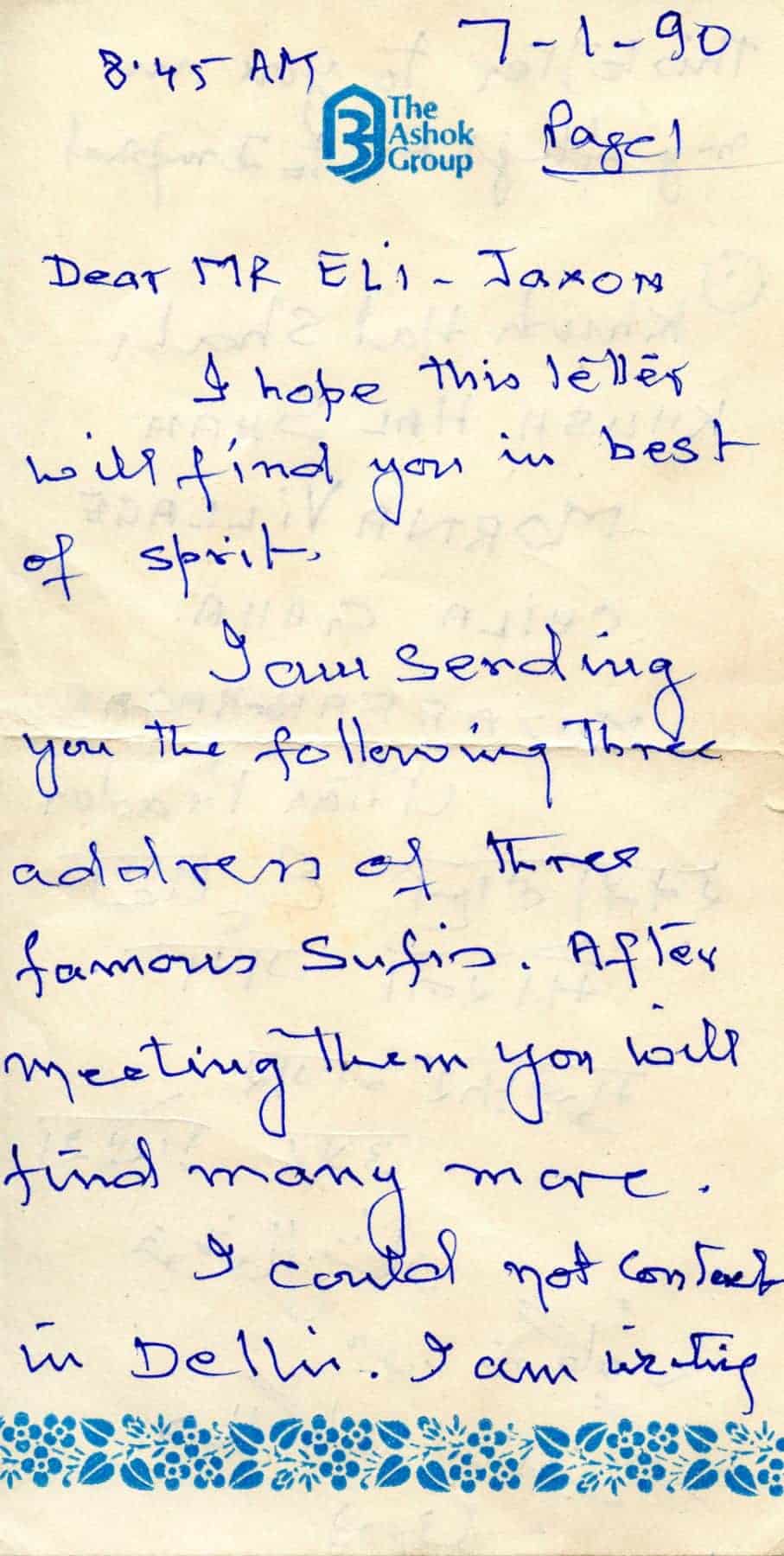
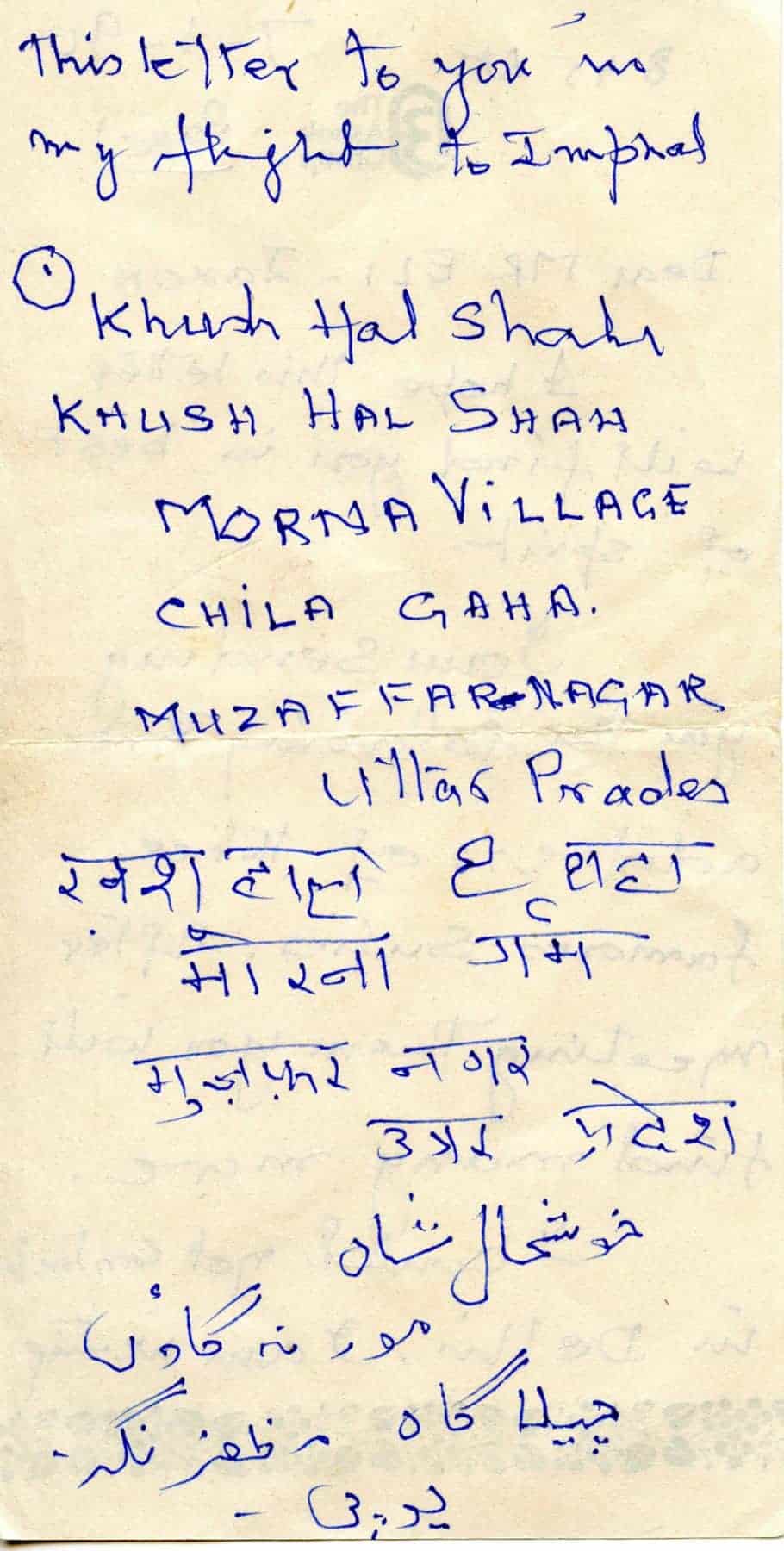
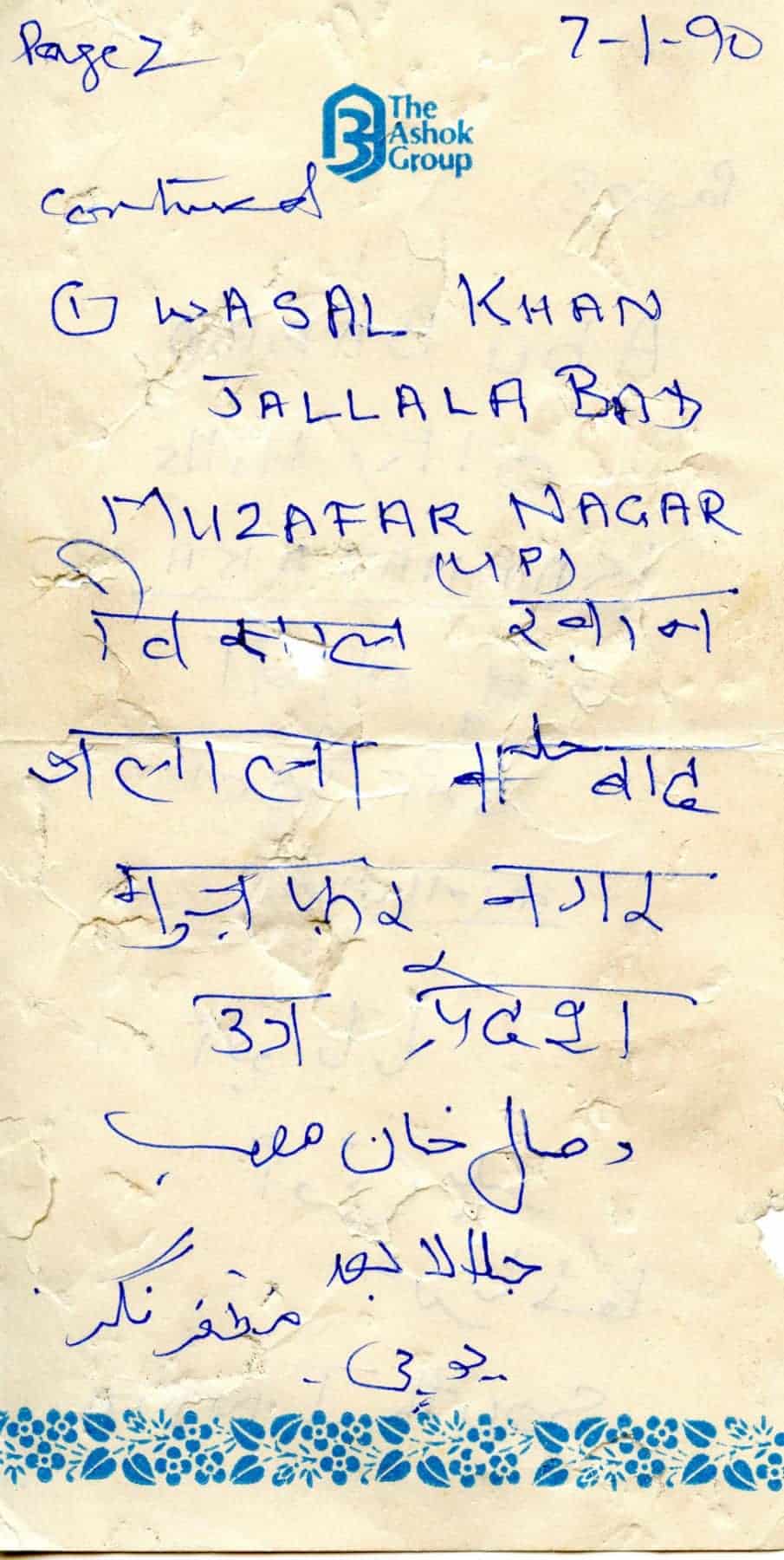
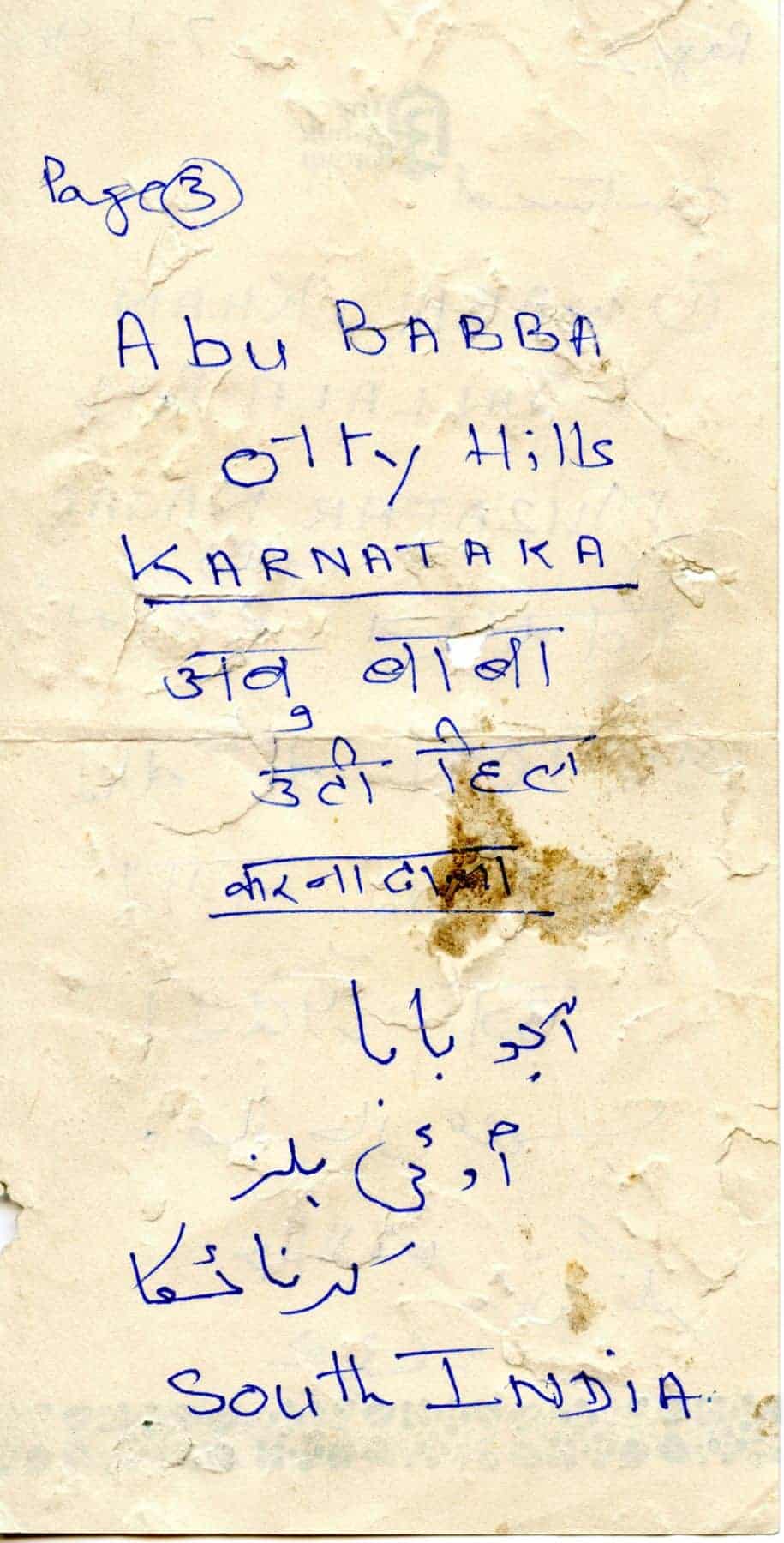
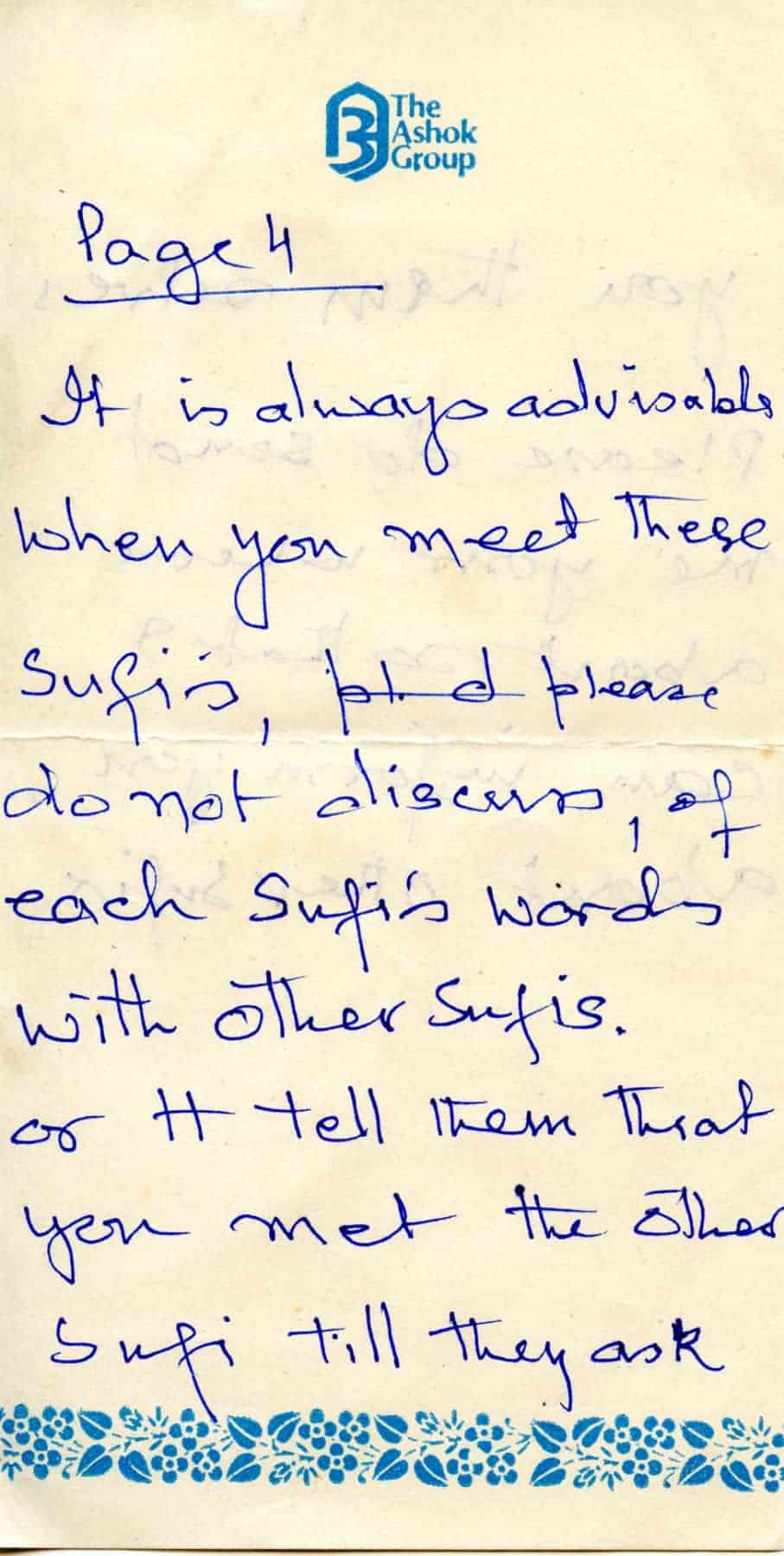
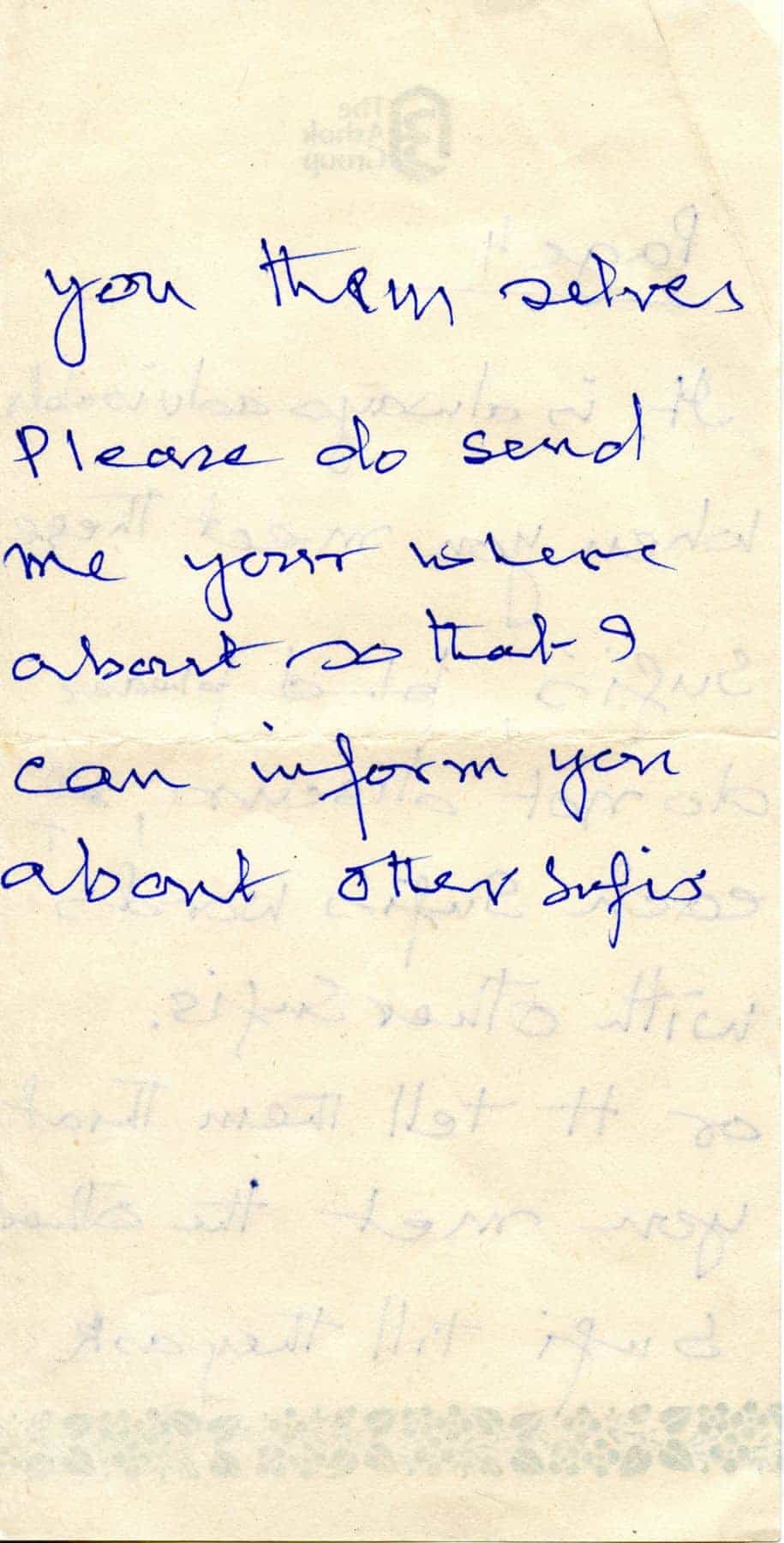
THE SUFI LETTER
Dear Mr Eli-Jaxon,
I hope this letter will find you in best of sprit.
I am sending you the following three address of three famous Sufis. After meeting them you will find many more. I could not contact in Delhi. I am writing this letter to you on my flight to Imphal.
1) Khush Hal Shah, Morna Village, Chila Gaha, Muzaffar Nagar, Uttar Pradesh
2) Wasal Khan, Jallalabad, Muzafar Nagar (UP)
3) Abu Babba, Ooty Hills, Karnataka, South India
It is always advisable when you meet these Sufis, please do not discuss each Sufi’s words with other Sufis, or tell them that you met the other Sufi till they ask you them selves.
Please do send me your whereabouts so that I can inform you about other Sufis.
The earliest document in the collection — and, in Eli’s memoir, the thread that led him to Lucknow. It is from the government official Eli met in Delhi, at the Sufi quarter of Nizamuddin; stationed in Lucknow, the official had the names of the great Sufis and wrote to send Eli the addresses of three of them. Dated January 7, 1990, it precedes Eli’s first meeting with Papaji on January 19.
Eli’s Letter from Toni
Toni Varner had not yet met Papaji, and was not yet Gangaji. She was at home in California, reading the letters Eli was sending from Lucknow. She would go to Papaji herself that April. This is an excerpt from what she wrote back.
February 9, 1990 — An excerpt from Toni’s letter to Eli
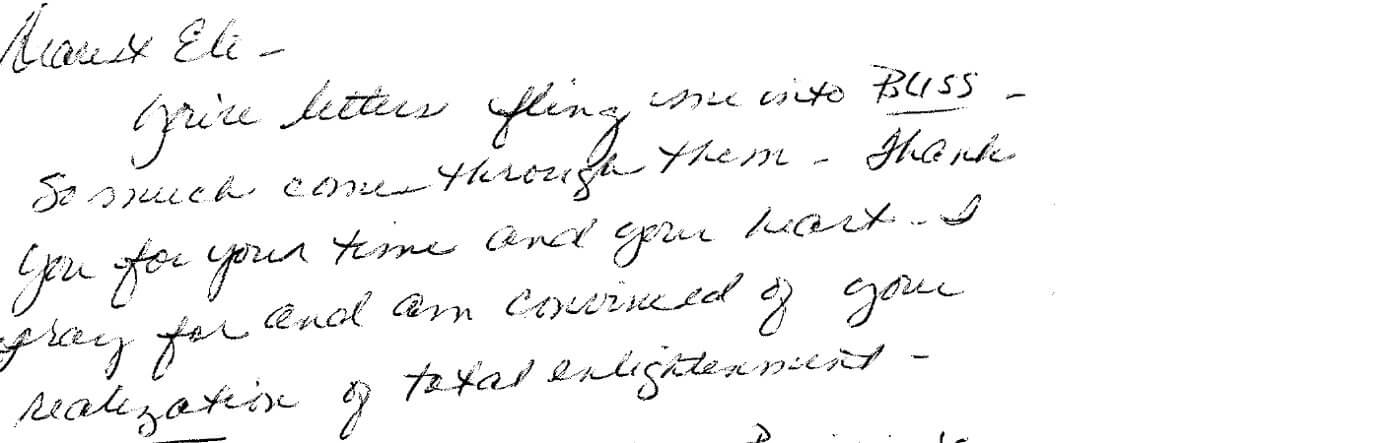
Dearest Eli —
Your letters fling me into BLISS — so much comes through them. Thank you for your time and your heart. I pray for and am convinced of your realization of total enlightenment. Thank you for your gift of Poonjaji’s love through your being to ours.
…
My love to Baba — he reaches me here through his son. Love’s waiting patiently to swallow us whole!
— Toni
Three weeks after Eli first climbed the stairs in Lucknow, the transmission is already traveling by mail, before Toni has met him at all. The letter also catches his names in transition. To those around him he was Poonjaji, and that is what Toni writes. Eli had begun calling him Baba, and in the same letter Toni sends her love to Baba. Papaji came afterward, when Eli noticed it was what the granddaughters in the house called him — and it was that name, carried out in Wake Up and Roar, that the world came to know him by. “He reaches me here through his son”: the whole arc of what followed is already moving in that line.
Papaji Letters to Eli: Chronological
Eli met Papaji in Lucknow on January 19, 1990. The letters that followed run through the years in which Wake Up and Roar was gathered, published, and carried back to India, in which Gangaji began to teach, and in which Papaji finally agreed to come to America. They are reproduced here as he wrote them, spelling and all. Two of them arrive with a second letter enclosed, which Papaji sent on rather than summarize. Two more are in the hands of Yamuna, his assistant in Lucknow — one carrying his instructions, one describing him.
July 17, 1990 — Lucknow
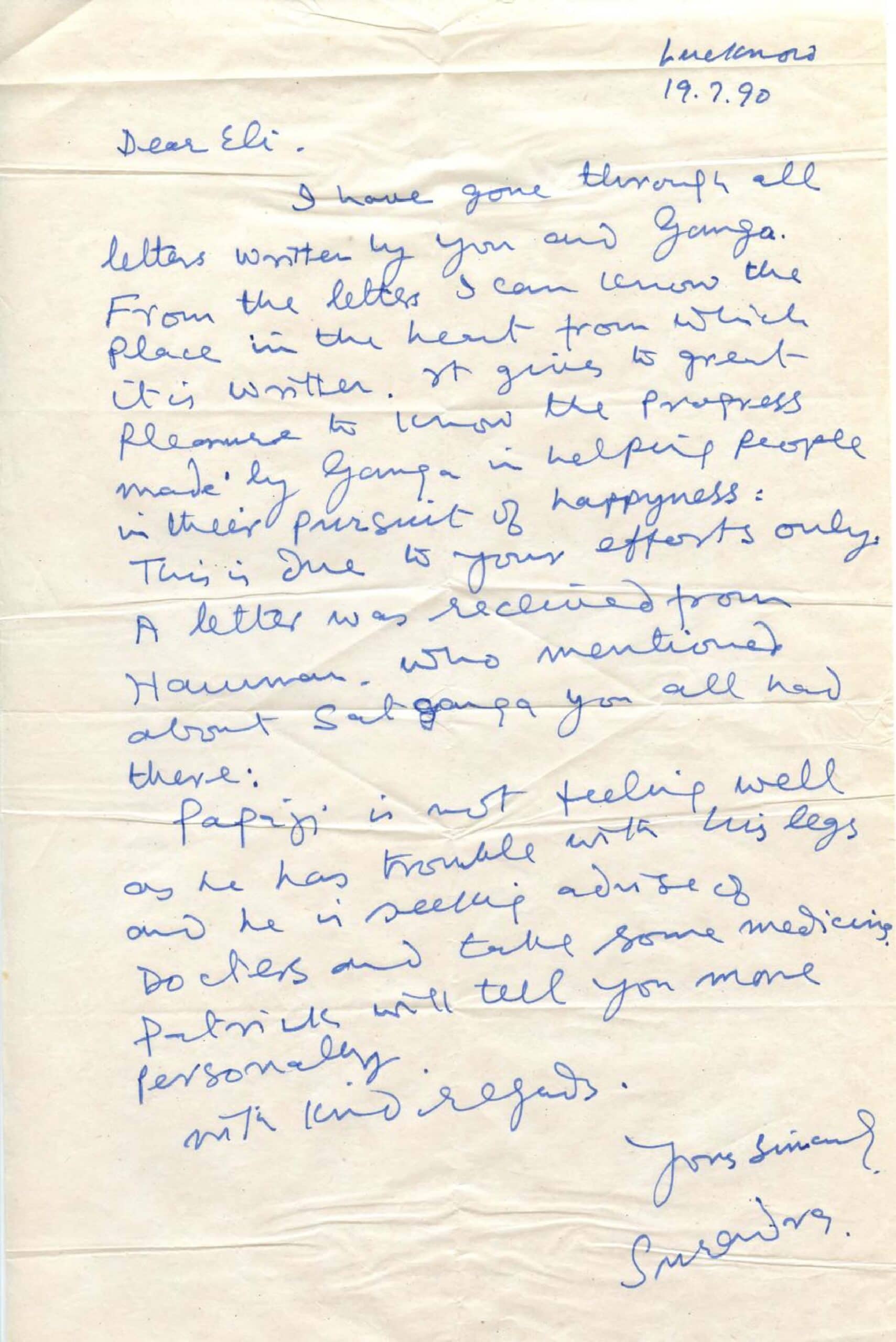
THE SURENDRA LETTER
July 17, 1990
Dear Eli,
I have gone through all letters written by you and Ganga. From the letters, I can know the place in the heart from which it is written. It gives me great pleasure to know the progress made by Ganga in helping people in their pursuit of happyness. This is due to your efforts only.
A letter was received from Hanuman who mentioned about the satsang you all had there. Papaji is not feeling well, as he has trouble with his legs, and he is seeking advice of the doctors and taking some medicine.
Perhaps I will tell you more personally.
With kind regards, yours sincerely, Surendra
From Surendra, Papaji’s son — the man who opened the door in Lucknow and told Eli, “He is upstairs. He is waiting for you,” the line that opens the Meeting Papaji account. Written in July 1990, in the months after Eli’s first January meeting.
December 17, 1990 — Lucknow
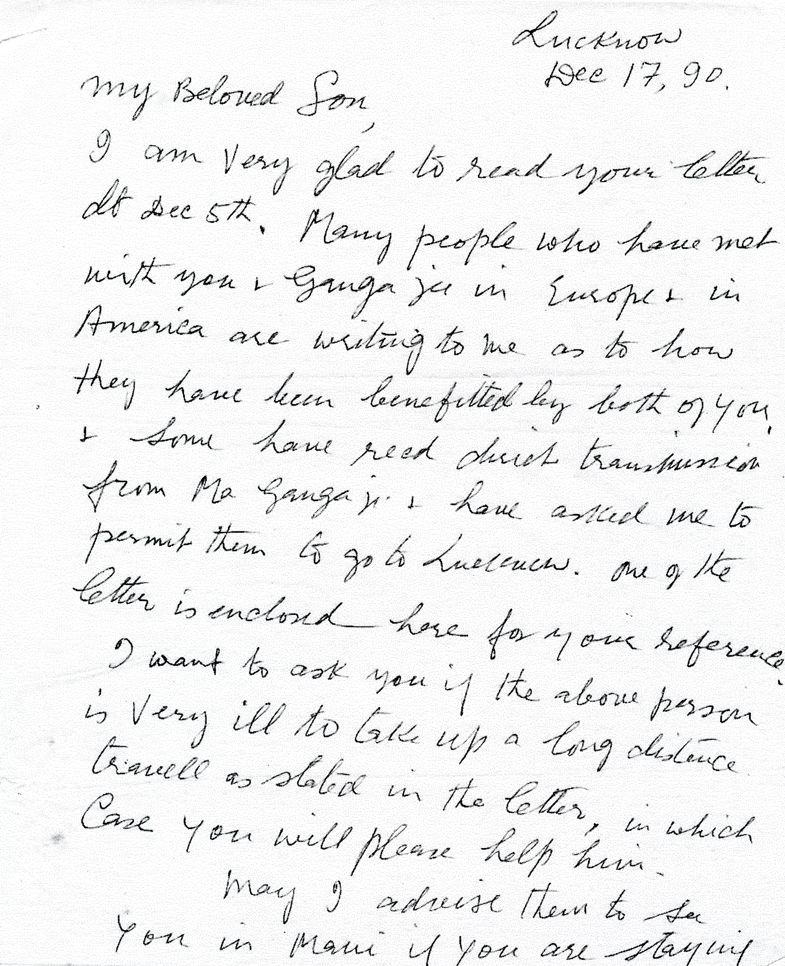
My Beloved Son,
I am very glad to read your letter dt Dec 5th. Many people who have met with you & Ganga ji in Europe & in America are writing to me as to how they have been benefitted by both of you, & some have rec’d direct transmission from Ma Ganga ji & have asked me to permit them to go to Lucknow. One of the letter is enclosed here for your reference.
I want to ask you if the above person is very ill to take up a long distance travell as stated in the letter, in which case you will please help him.
May I advise them to see you in Maui if you are staying.
Papaji reports the early fruit of Eli and Gangaji’s work in Europe and America — people writing to Lucknow describing how they were helped, some asking permission to come. He defers to Eli on whether to send a frail correspondent the long distance, and floats directing people to meet Eli in Maui.
January 17, 1991 — Lucknow
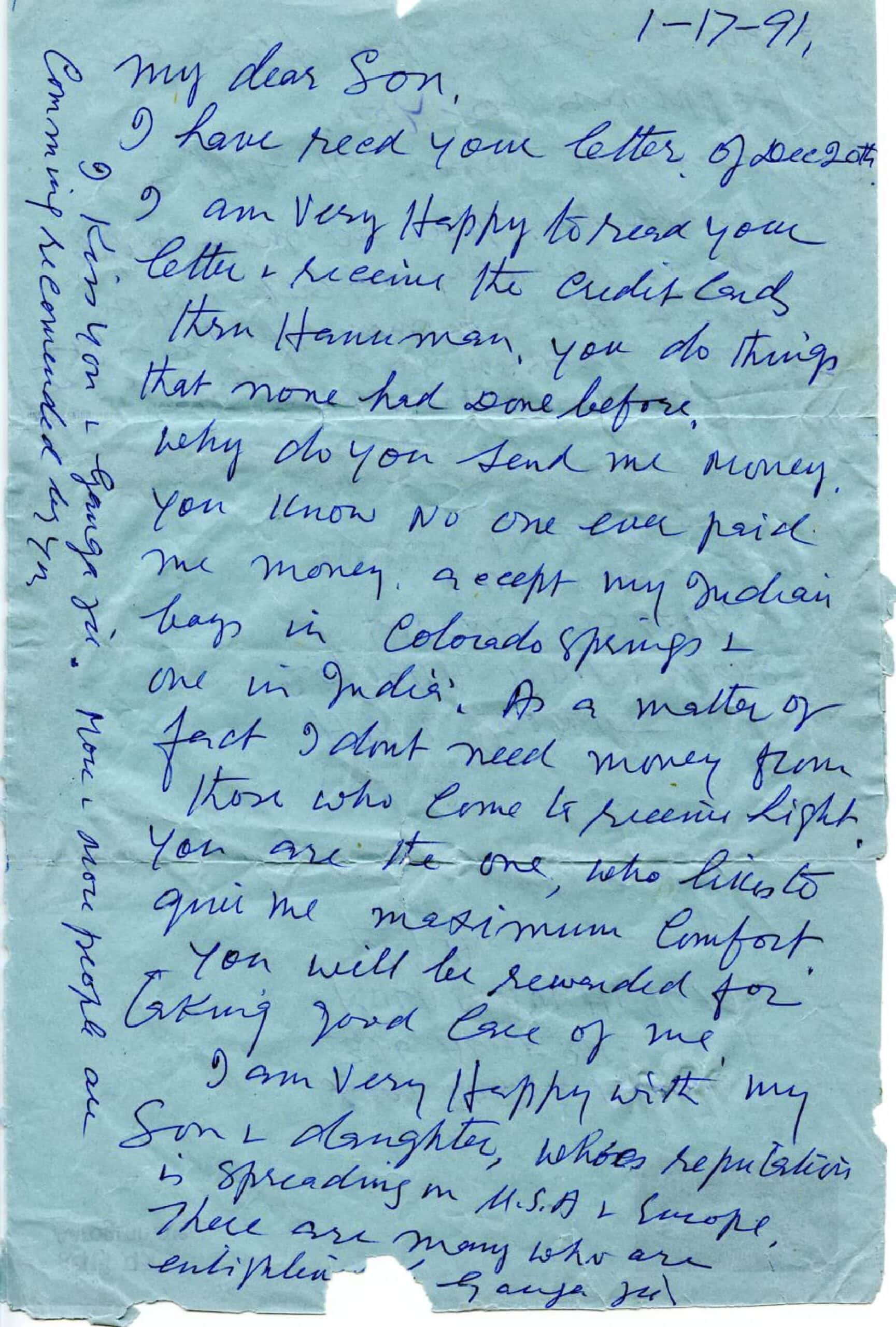
My dear Son,
I have rec’d your letter of Dec 20th.
I am very happy to read your letter & receive the credit cards thru Hanuman. You do things that none had done before. Why do you send me money. You know no one ever paid me money. Except my Indian boys in Colorado Springs & one in India. As a matter of fact I dont need money from those who come to receive light. You are the one who likes to give me maximum comfort & you will be rewarded for taking good care of me.
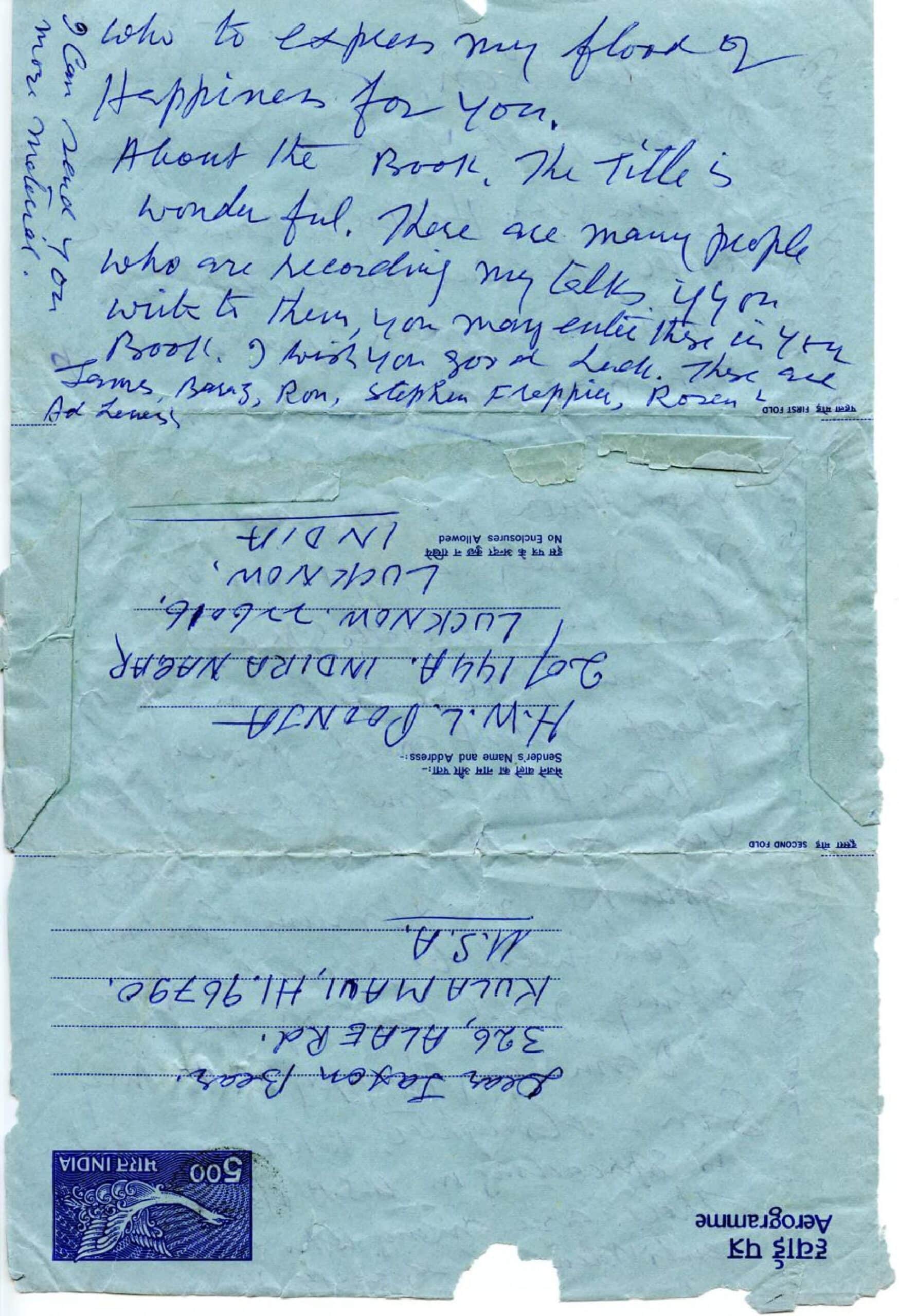
I am very happy with my Son & daughter, whose reputation is spreading in U.S.A & Europe. There are many who are enlightened — Ganga jee … how to express my flood of Happiness for you.
About the Book — the title is wonderful. There are many people who are recording my talks. If you write to them, you may enter these in your Book. I wish you good Luck. These are James, Barry, Ron, Stephen, Freppin, Rosen.
I can send you more material.
A tender, half-scolding letter about Eli sending him credit cards and money. “No one ever paid me money — except my Indian boys”: Papaji took support only from his own family of Indian devotees, never from the Western seekers who came for light. “You will be rewarded for taking good care of me.” Page two turns to the book Eli was assembling — “the title is wonderful” — and Papaji offers the names of those recording his talks, so their transcripts might be gathered in.
February 7, 1991 — Indira Nagar, Lucknow
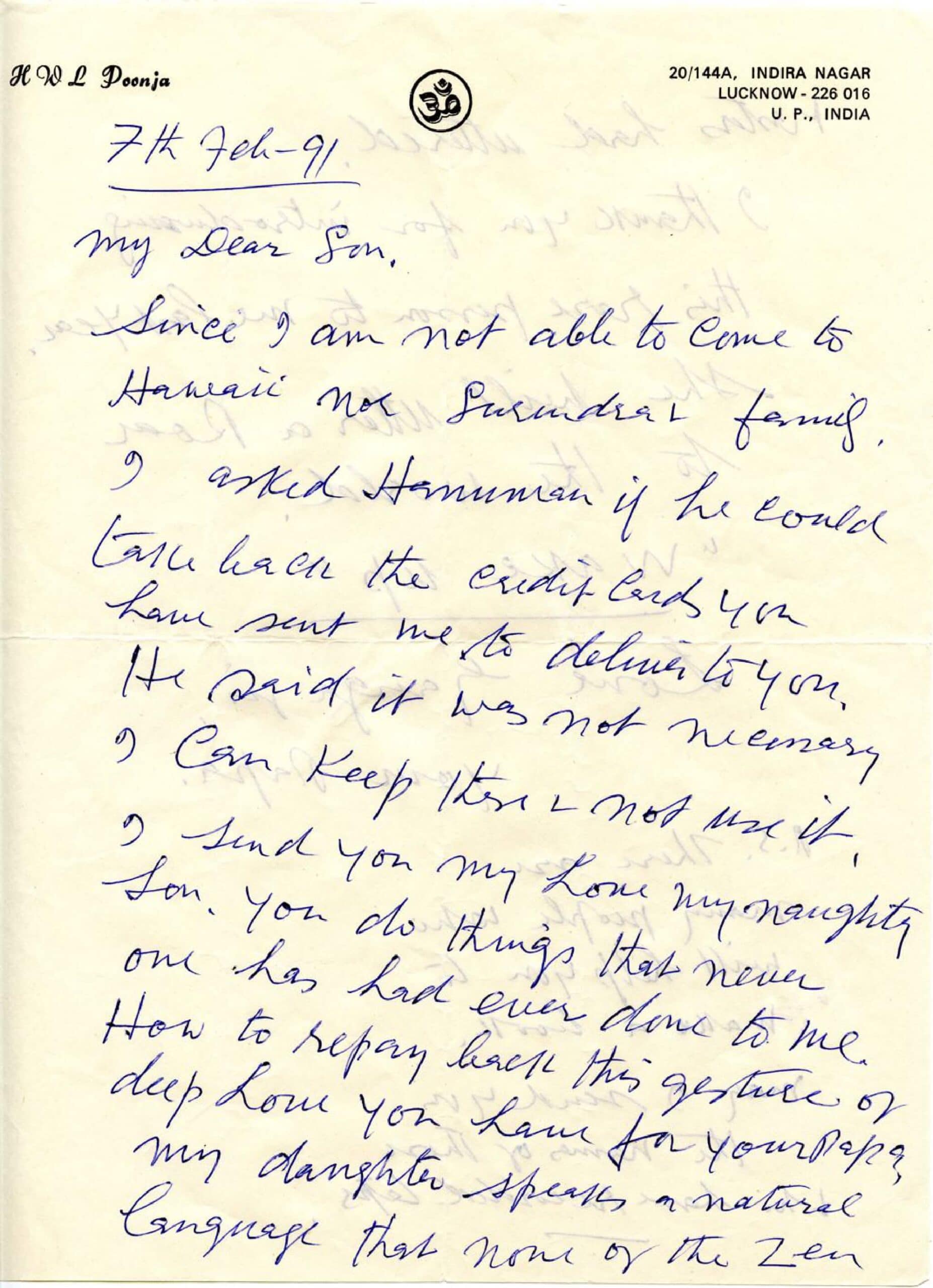
My Dear Son,
Since I am not able to come to Hawaii nor Surendra & family.
I asked Hanuman if he could take back the credit cards you have sent me to deliver to you. He said it was not necessary. I can keep them & not use it.
I send you my Love my naughty Son. You do things that never one has had ever done to me. How to repay back this gesture of deep Love you have for your Papa.
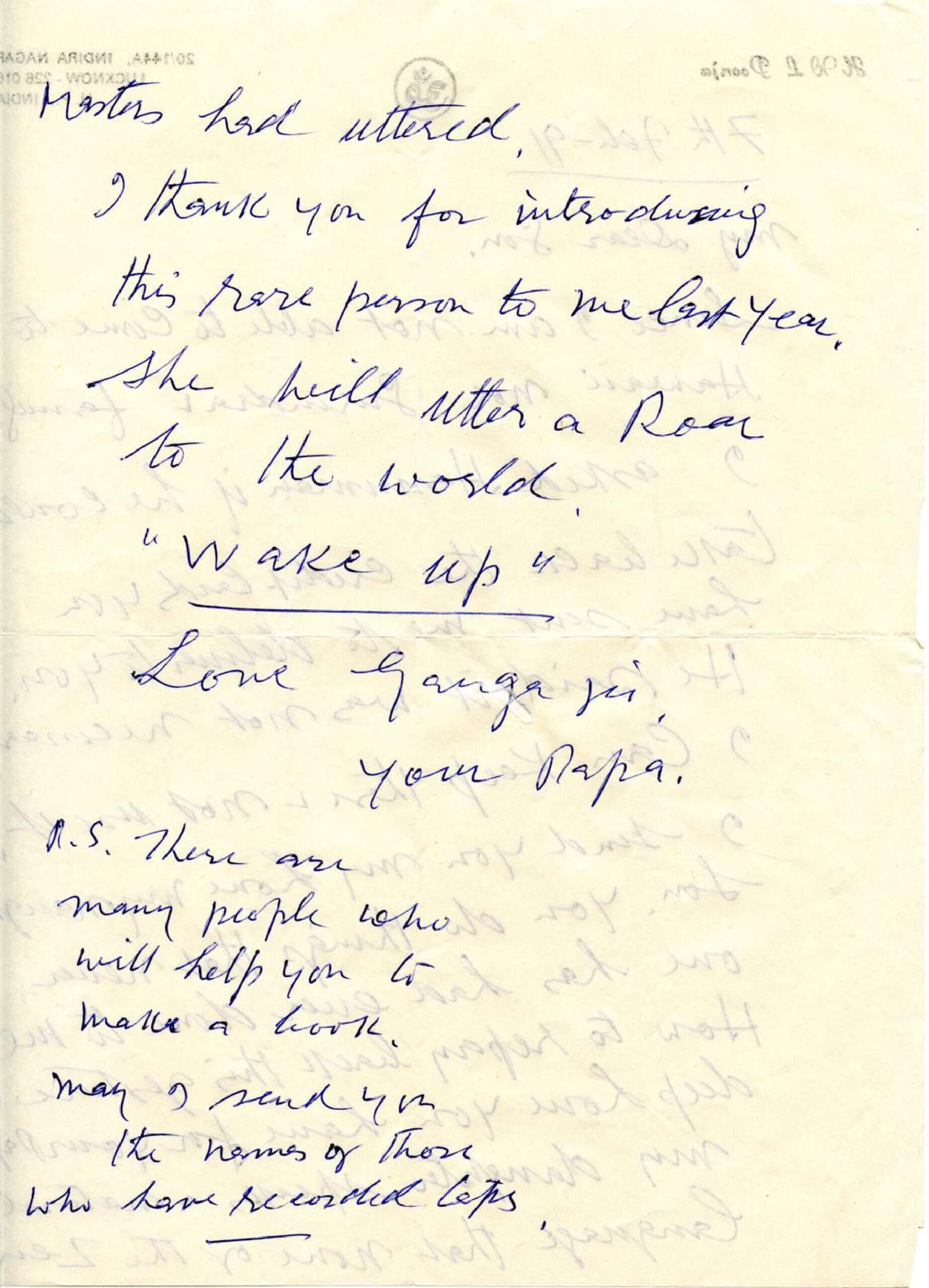
My daughter speaks a natural language that none of the Zen Masters had uttered. I thank you for introducing this rare person to me last year. She will utter a Roar to the world. “Wake Up.“
Love Ganga ji, your Papa.
P.S. There are many people who will help you to make a book. May I send you the names of those who have recorded tapes.
The sequel to the January letter: Papaji has sent the credit cards back via Hanuman, who told him it wasn’t necessary, so he keeps them unused — “my naughty Son,” affectionate exasperation at Eli’s generosity. Page two turns fully to Gangaji, “my daughter,” who “speaks a natural language that none of the Zen Masters had uttered.” Papaji thanks Eli for introducing her to him the year before and foretells what is coming: “She will utter a Roar to the world. Wake Up.” — the very words that would name the book. A closing postscript offers the names of those who had recorded tapes, help toward making it.
October 18, 1991 — Indira Nagar, Lucknow
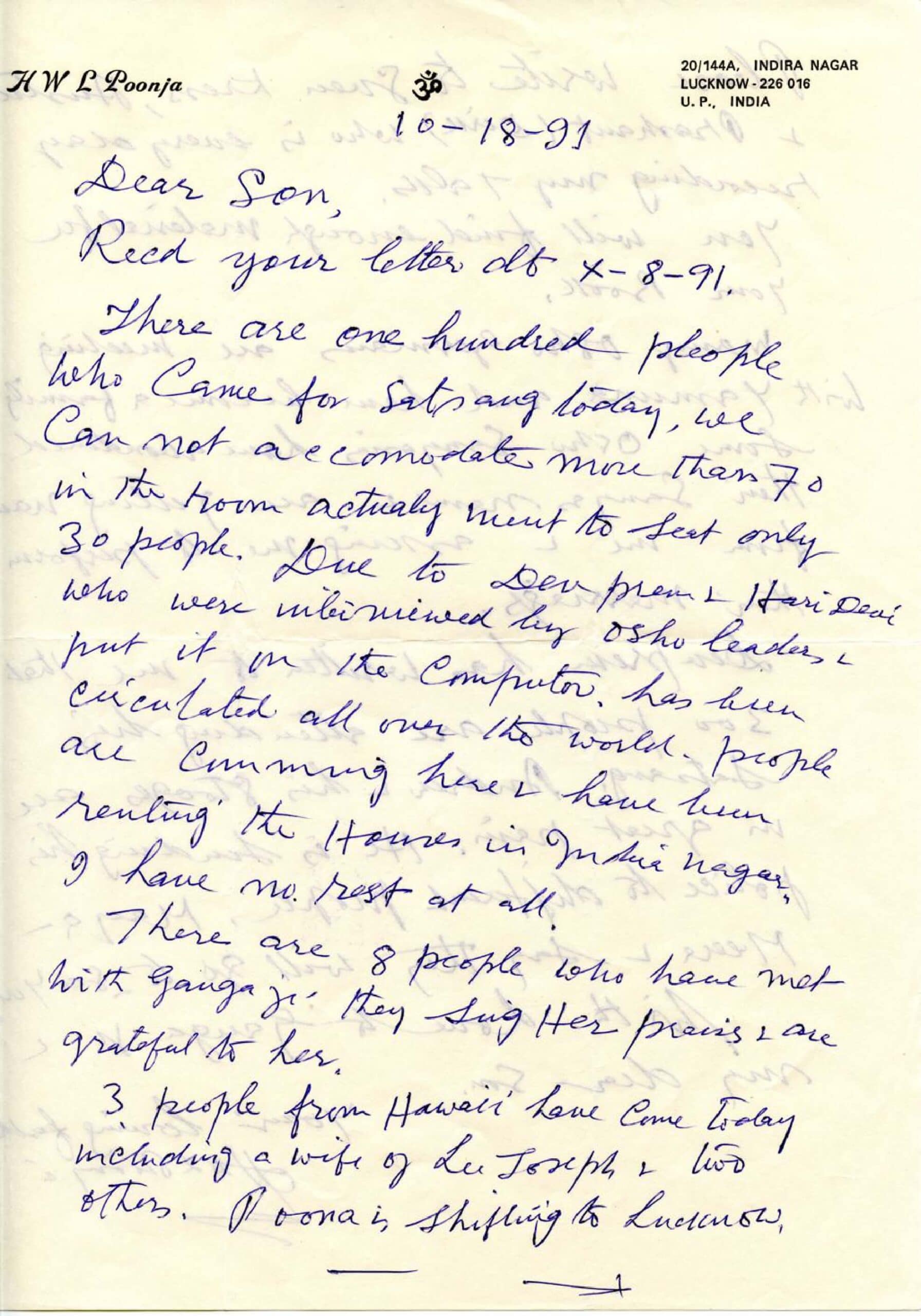
Dear Son,
Rec’d your letter dt 10-8-91.
There are one hundred people who came for Satsang today, we can not accomodate more than 70 in the room actualy ment to seat only 30 people. Due to Dev Prem & Hari Devi who were interviewed by Osho leaders & put it on the Computor, has been circulated all over the world. People are comming here & have been renting the houses in Indira Nagar. I have no rest at all.
There are 8 people who have met with Ganga ji. They sing Her praise & are gratful to her.
3 people from Hawaii have come today including a wife of Lee Joseph & two others. Poona is shifting to Lucknow.
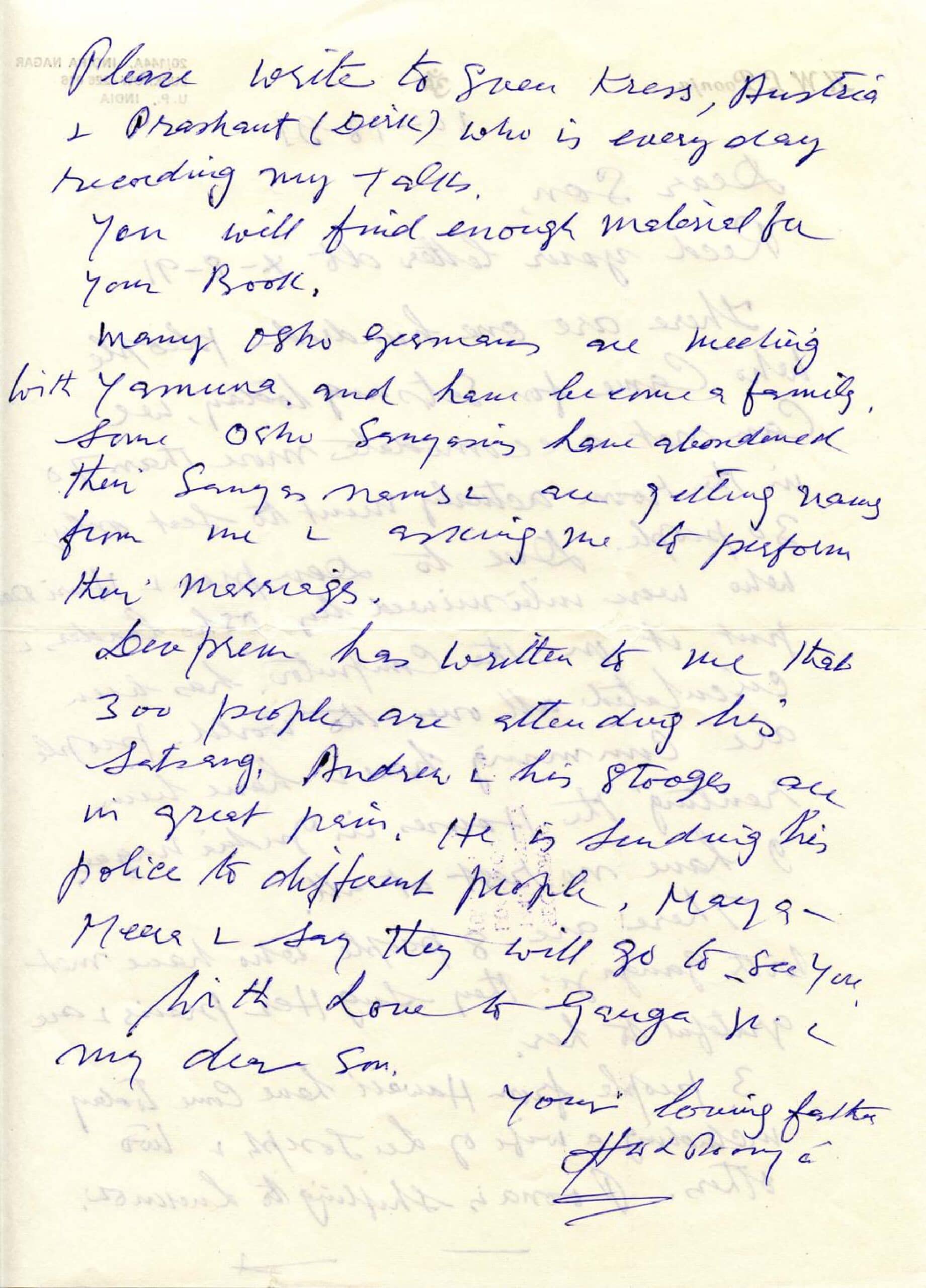
Please write to Sven Kress, Austria, & Prashant (Dirk) who is every day recording my talks.
You will find enough material for your Book.
Many Osho Germans are meeting with Yamuna, and have become a family. Some Osho Sanyasins have abandoned their Sanyas names & are getting names from me & asking me to perform their marriages.
Devaprem has written to me that 300 people are attending his Satsang. Andrew & his stooges are in great pain. He is sending his police to different people. Maya, Meera & say they will go to see you.
With Love to Ganga ji & my dear Son. Your loving father, H W L Poonja
A vivid snapshot of the moment the Lucknow satsangs exploded: a hundred people in a room built for thirty. Papaji credits an Osho-leaders interview — “put on the Computer” — circulating worldwide, and notes “Poona is shifting to Lucknow” as the Pune sannyasins arrived in waves. Page two deepens the picture: Osho sannyasins are shedding their sannyas names, taking new ones from Papaji and asking him to perform their marriages, while the German contingent gathers around Yamuna and “have become a family.” Papaji points Eli to more people recording his talks — “you will find enough material for your Book” — and the Andrew rift surfaces here too: “Andrew & his stooges are in great pain.”
November 27, 1991 — Indira Nagar, Lucknow
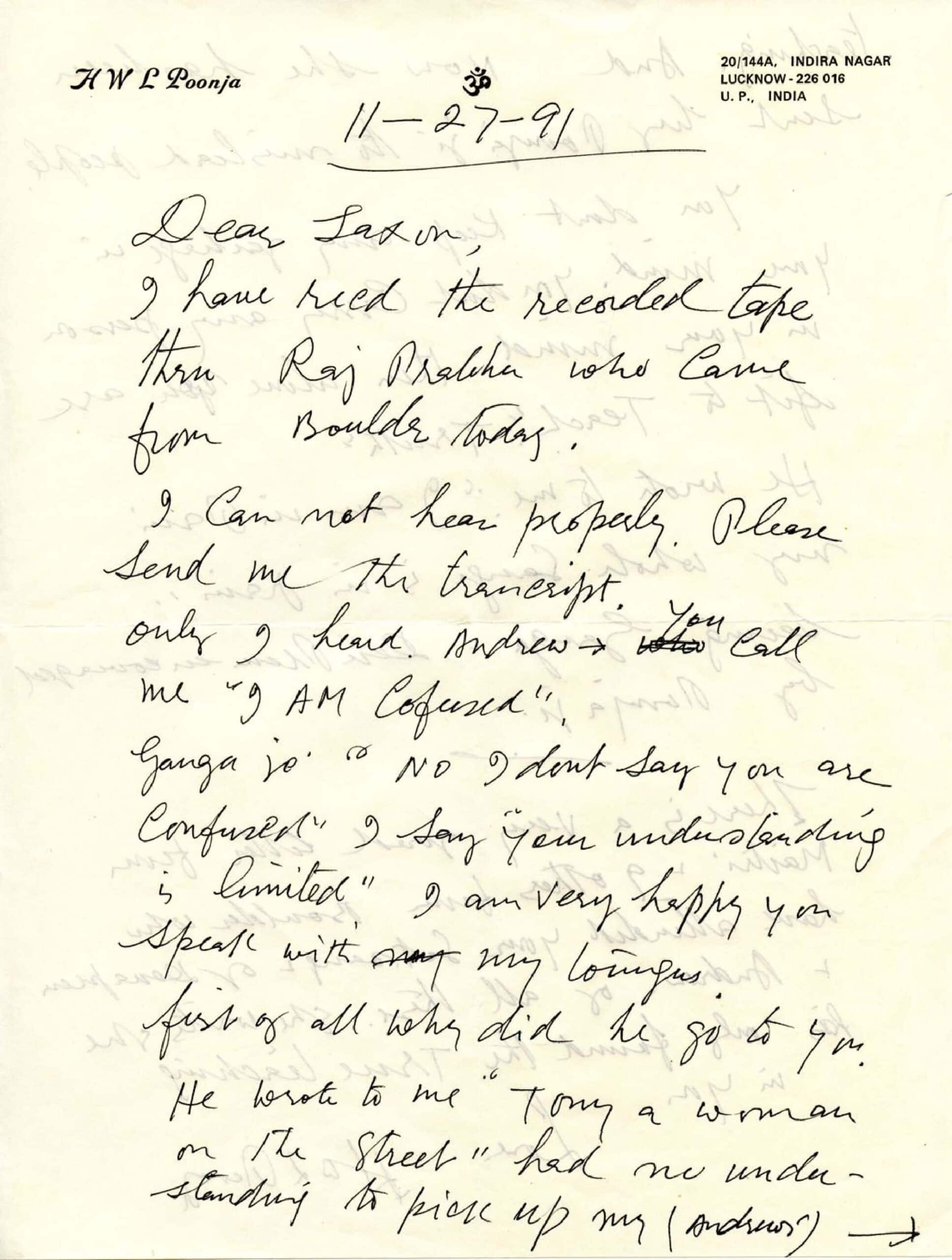
Dear Jaxon,
I have rec’d the recorded tape thru Raj Prakash who came from Boulder today.
I can not hear properly. Please send me the transcript. Only I heard:
Andrew: “[You think] I am confused.”
Ganga ji: “No, I dont say you are confused. I say your understanding is limited.”
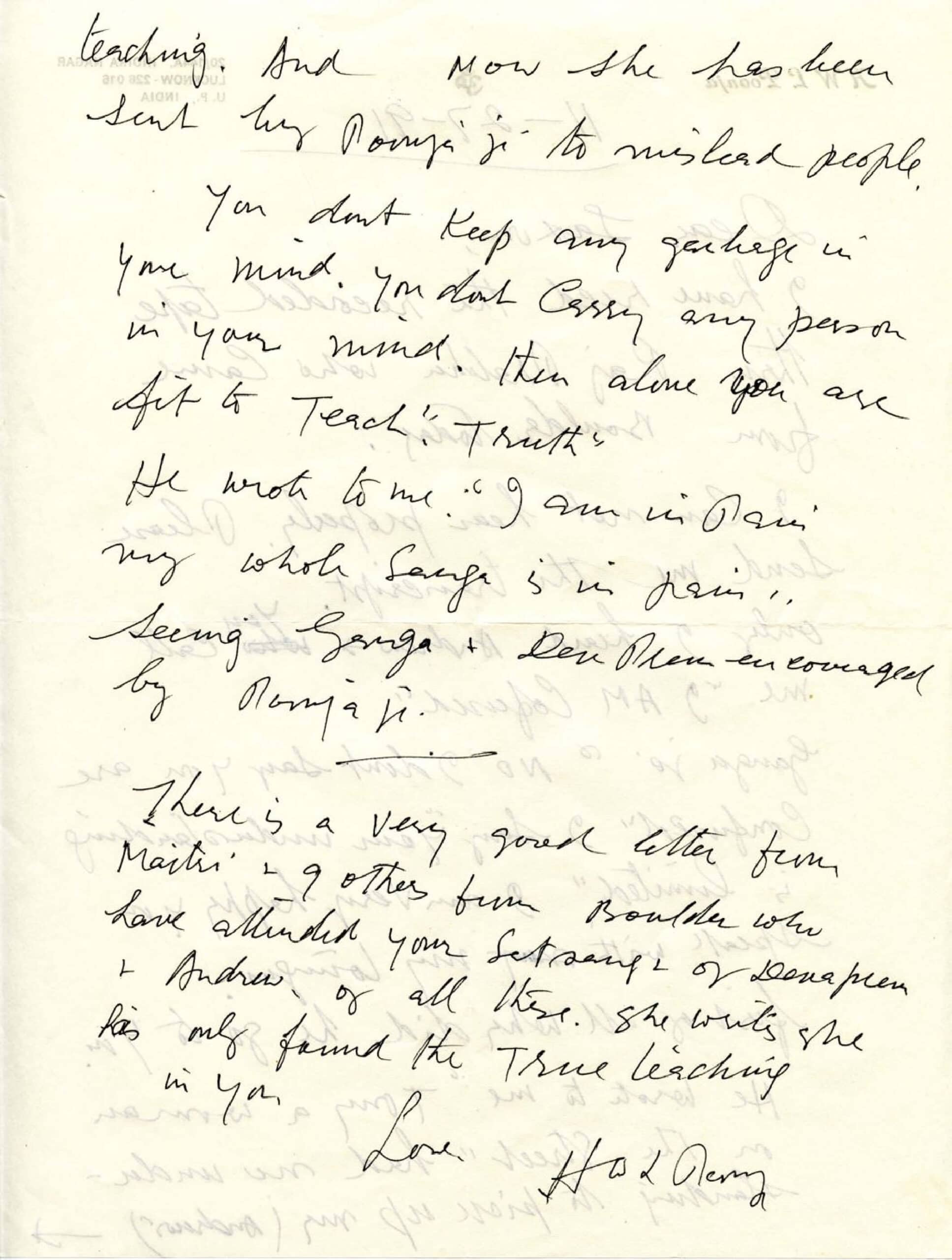
I am very happy you speak with my tongue. First of all why did he go to you. He wrote to me “Tony, a woman on the street” had no understanding to pick up my (Andrew’s) teaching. And now she has been sent by Poonja ji to mislead people.
You dont keep any garbage in your mind. You dont carry any person in your mind. then alone you are fit to Teach “Truth.”
He wrote to me: “I am in Pain, my whole Sanga is in pain.” Seeing Ganga & Dev Prem encouraged by Poonja ji.
There is a very good letter from Maitri & 9 others from Boulder who have attended your Satsang & of Devaprem & Andrew. Of all these, she writes she has only found the True teaching in you.
Love, H W L Poonja
Possibly the most historically significant letter in the set. The “recorded tape” is the Berkeley satsang in which Andrew comes to Gangaji and she meets his “you think I am confused” with her precise correction — not confused, but limited in understanding. Made by Richard, a volunteer from Conference Recording Studios, that tape traveled the world and launched Gangaji’s international reputation. Here Papaji — hearing a poor-quality copy in Lucknow — quotes the exchange and asks Eli for the transcript. Page two carries the rupture to its point: Papaji relays Andrew’s grievance — that Gangaji “had no understanding… and now she has been sent by Poonja ji to mislead people,” that “I am in pain, my whole Sangha is in pain” — and answers it with instruction to Eli: “You don’t keep any garbage in your mind… then alone you are fit to teach Truth.” He closes with a letter from Maitri and nine others from Boulder who, having sat with Eli, Devaprem and Andrew, found the true teaching only in Eli.
June 8, 1992 — Lucknow
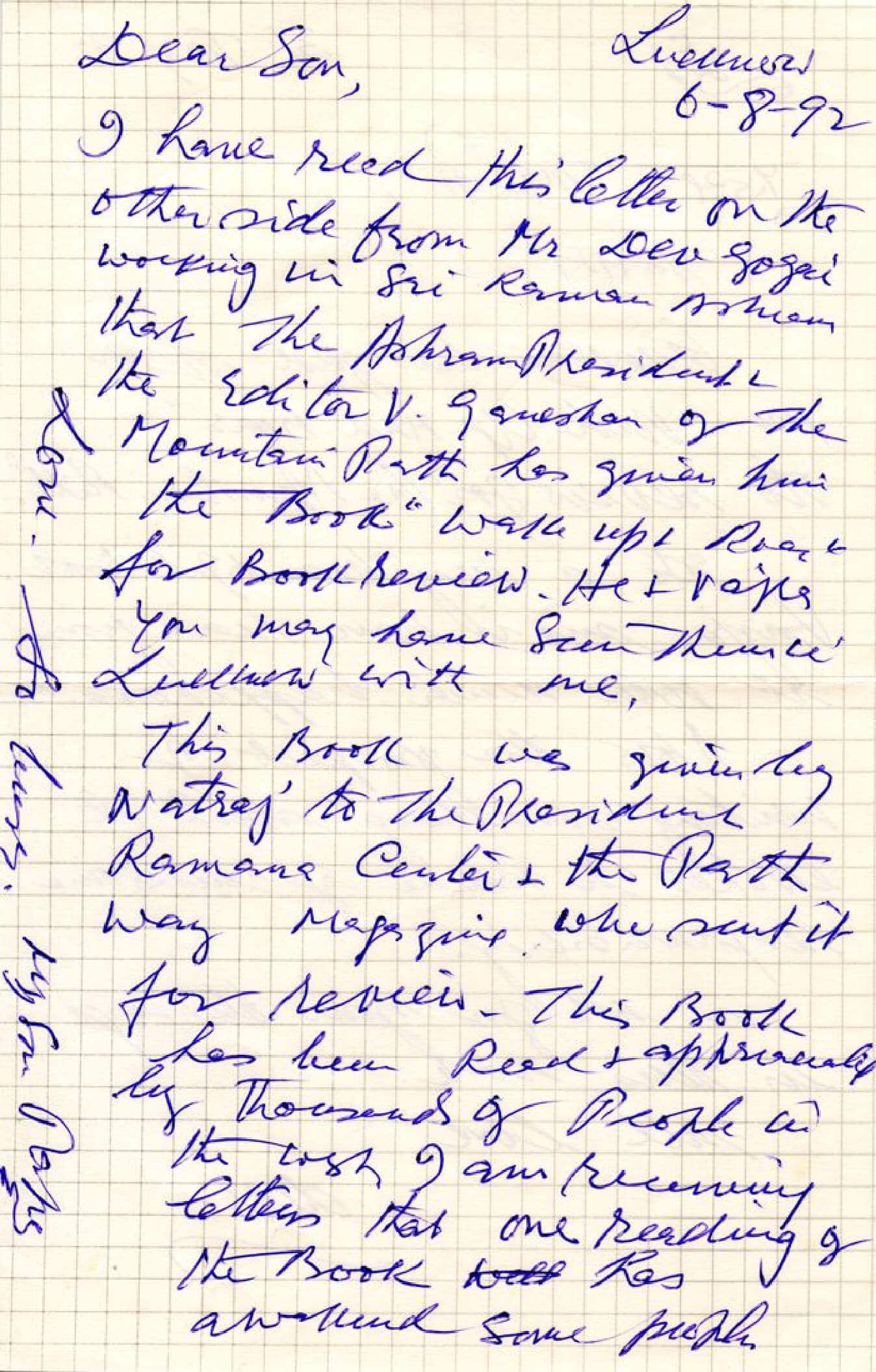
Dear Son,
I have rec’d this letter on the other side from Mr Dev Gogi working in Sri Ramana Ashram, that the Ashram President & the Editor V. Ganeshan of the Mountain Path has given him “the Book” Wake Up & Roar for book review. He & Raj — you may have seen them in Lucknow with me.
This Book was given by Nataraj to the President, Ramana Center & the Path Way Magazine, who sent it for review. This Book has been read & appreciated by thousands of people at the Ashram. I am receiving letters that one reading of the Book has awakened some people.
Love & blessings, your Papa
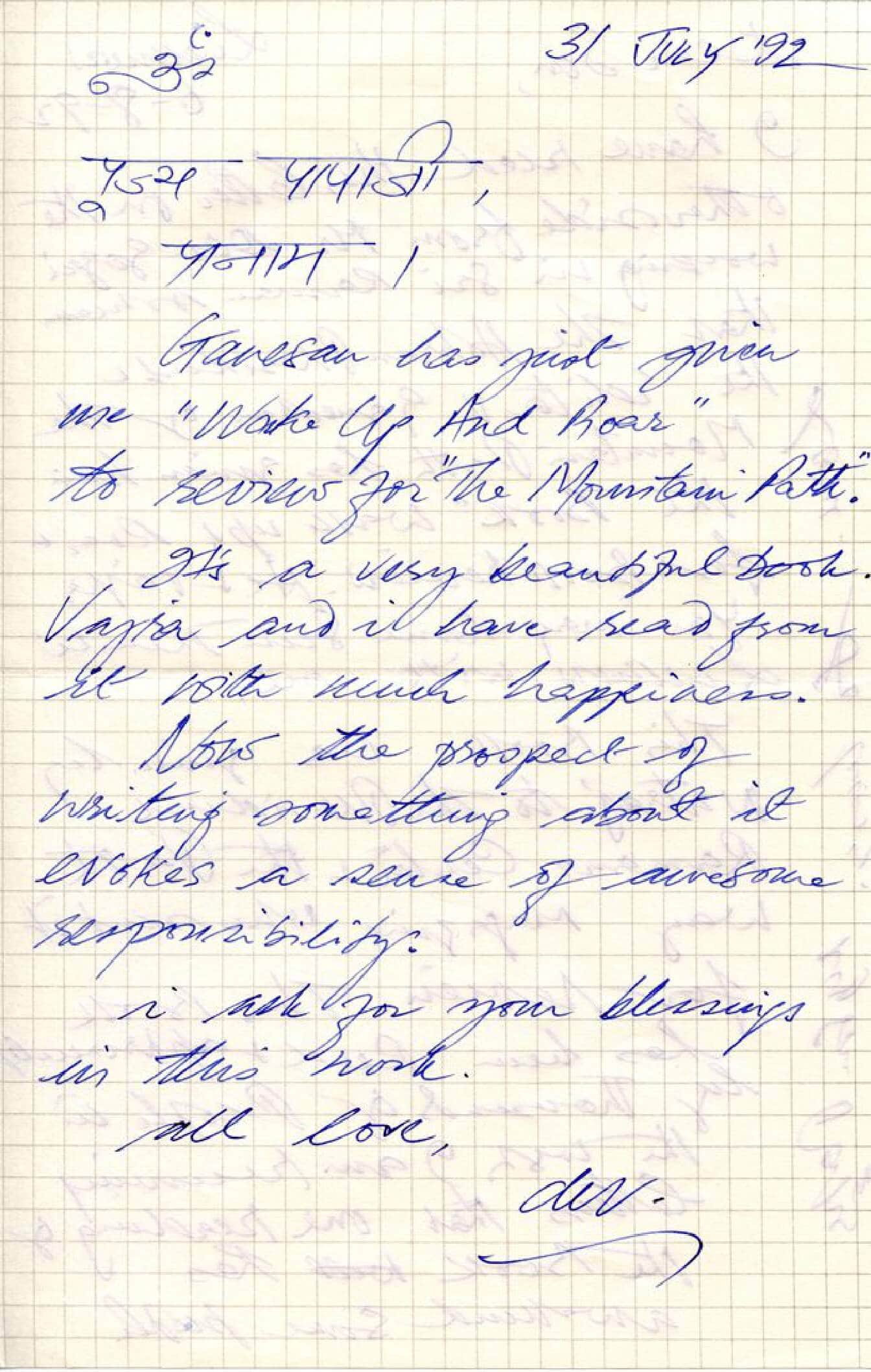
31 July ’92
[Hindi salutation — “Revered Father, greetings”]
Ganesan has just given me “Wake Up And Roar” to review for “The Mountain Path.” It’s a very beautiful book. Vajra and I have read from it with much happiness. Now the prospect of writing something about it evokes a sense of awesome responsibility. I ask for your blessings in this work.
All love, AV
Papaji forwards a letter he has received and writes on the reverse of it. Ramanashram has given Wake Up and Roar to The Mountain Path for review — V. Ganesan, the editor, handing it to a devotee who reads it with Vajra and asks Papaji’s blessing before writing. Papaji reports that thousands at the Ashram have read it, and that letters are arriving saying a single reading awakened them. The gesture underneath the news is the point: he did not summarize it, he sent the letter itself, so Eli could see with his own eyes that Ramana’s ashram had received the book.
April 21, 1993 — Indira Nagar, Lucknow
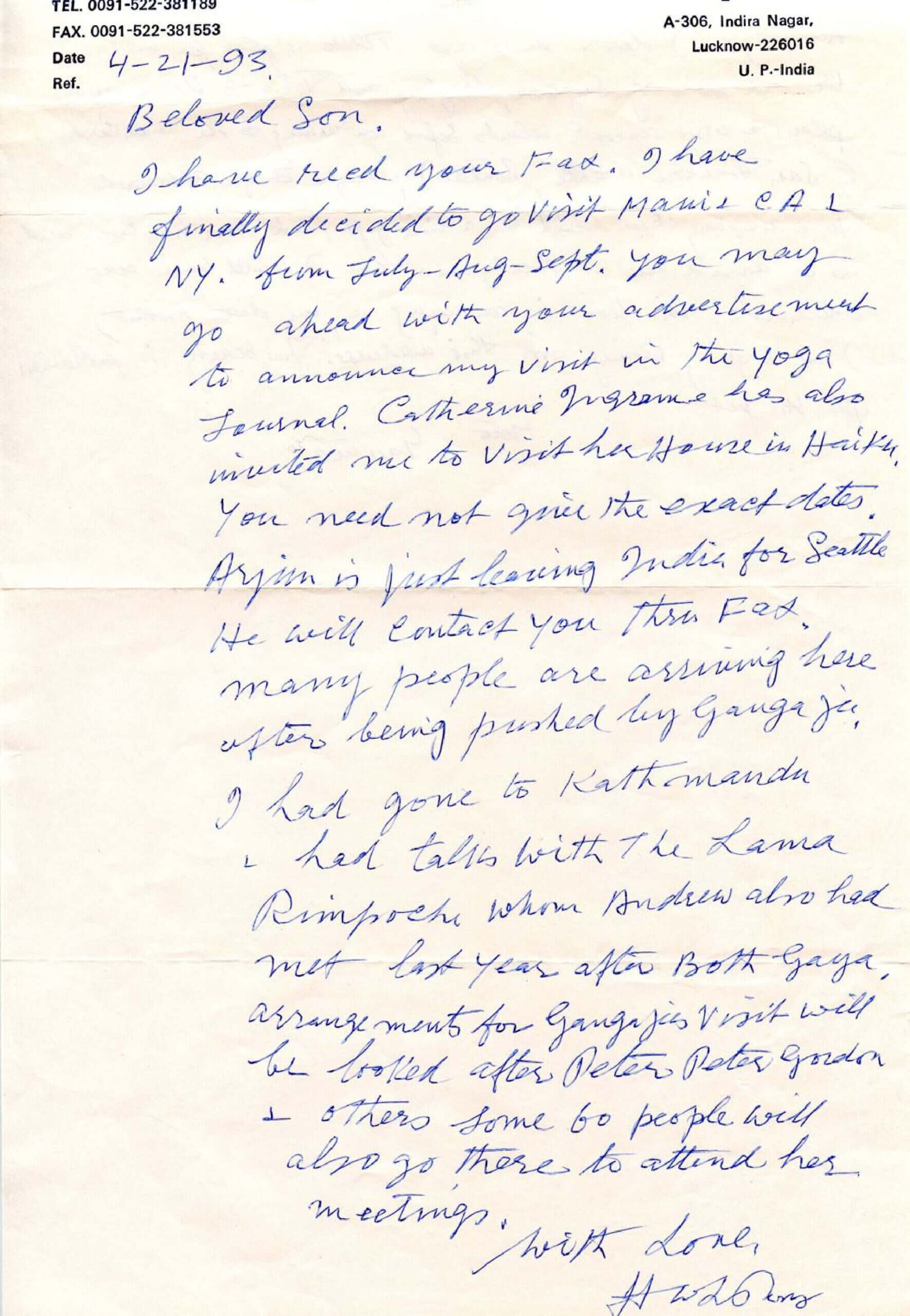
Beloved Son,
I have rec’d your Fax. I have finally decided to go visit Maui & CA & NY from July–Aug–Sept. You may go ahead with your advertisement to announce my visit in the Yoga Journal. Catherine Ingram has also invited me to visit her house in Haiku. You need not give the exact dates.
Arjun is just leaving India for Seattle. He will contact you thru Fax. Many people are arriving here after being pushed by Ganga ji.
I had gone to Kathmandu & had talks with the Lama Rinpoche whom Andrew also had met last year after Bodh Gaya. Arrangements for Ganga ji’s visit will be looked after [by] Peter — Peter Gordon — & others. Some 60 people will also go there to attend her meetings.
With Love, H W L Poonja
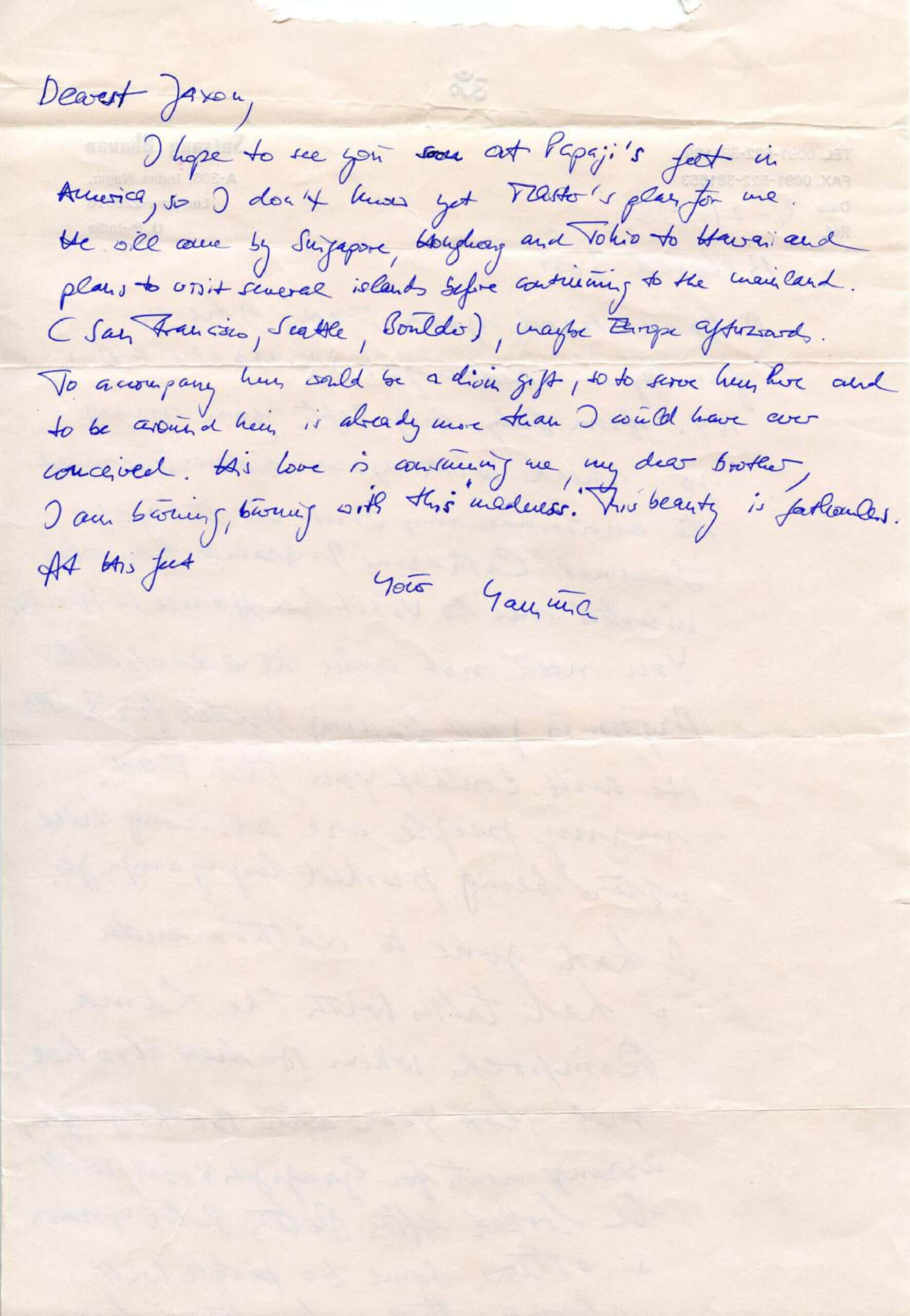
Dearest Jaxon,
I hope to see you soon at Papaji’s feet in America — I don’t know yet Master’s plan for me. He will come by Singapore, Hong Kong and Tokyo to Hawaii, and plans to visit several islands before continuing to the mainland (San Francisco, Seattle, Boulder), maybe Europe afterwards.
To accompany him would be a divine gift, to serve him here and to be around him is already more than I could have ever conceived. This love is consuming me, my dear brother, I am burning, burning with this madness. This beauty is fathomless.
At his feet — Yours, Yamuna
The decision Eli had waited years for: Papaji will come. Maui, California, New York, July through September, with permission to announce the visit in Yoga Journal — dates to follow. Catherine Ingram has offered her home in Haiku. Around it, the movement of that year: Arjun leaving for Seattle, the Kathmandu meeting with Lama Rinpoche, sixty people preparing to gather for Gangaji. Enclosed is a letter from Yamuna, who served Papaji daily in Lucknow and did not yet know whether she would be allowed to travel with him — “I am burning, burning with this madness.”
May 7, 1993 — Indira Nagar, Lucknow
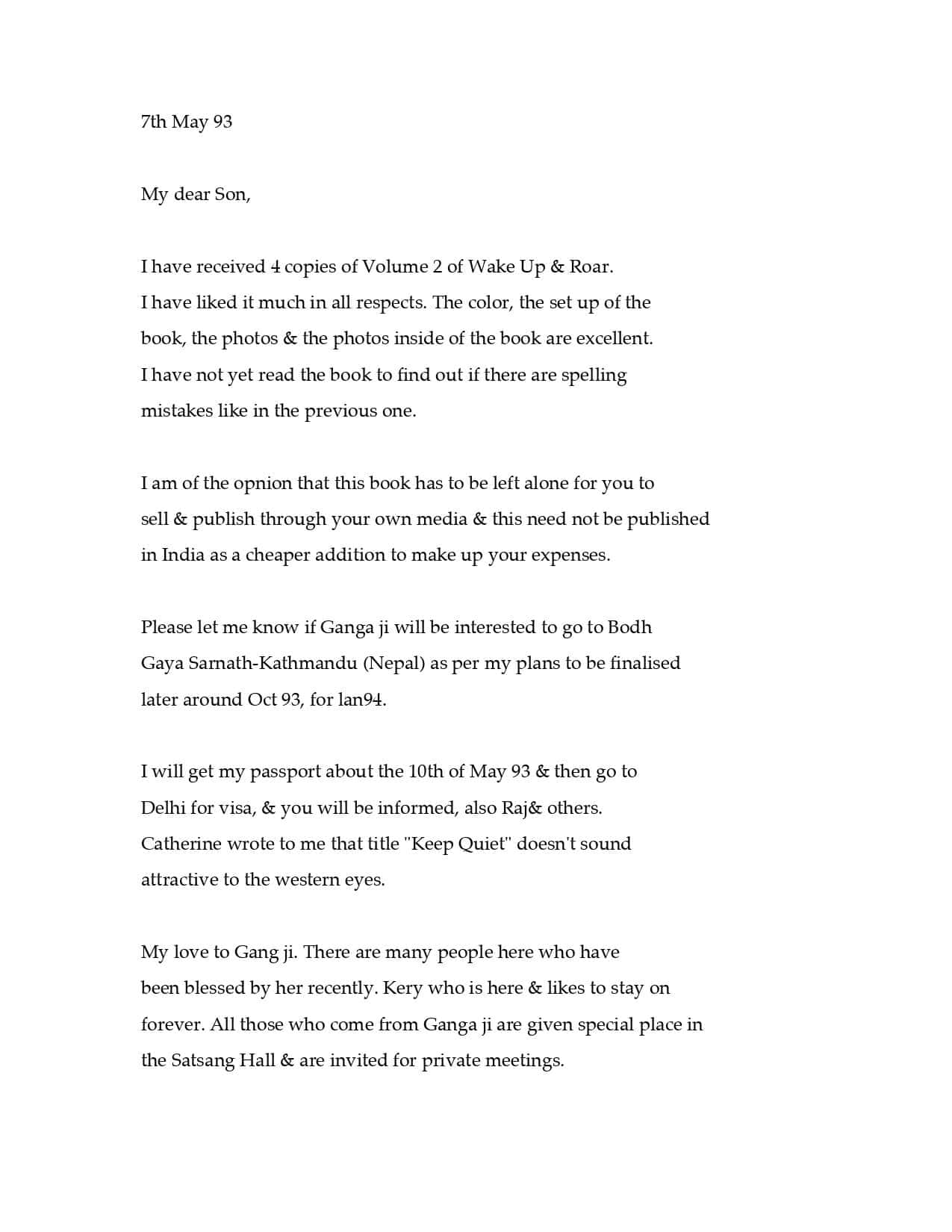
My dear Son,
I have received 4 copies of Volume 2 of Wake Up & Roar. I have liked it much in all respects. The color, the set up of the book, the photos & the photos inside of the book are excellent. I have not yet read the book to find out if there are spelling mistakes like in the previous one.
I am of the opnion that this book has to be left alone for you to sell & publish through your own media & this need not be published in India as a cheaper addition to make up your expenses.
Please let me know if Ganga ji will be interested to go to Bodh Gaya Sarnath-Kathmandu (Nepal) as per my plans to be finalised later around Oct 93, for Jan 94.
I will get my passport about the 10th of May 93 & then go to Delhi for visa, & you will be informed, also Raj & others. Catherine wrote to me that title “Keep Quiet” doesn’t sound attractive to the western eyes.
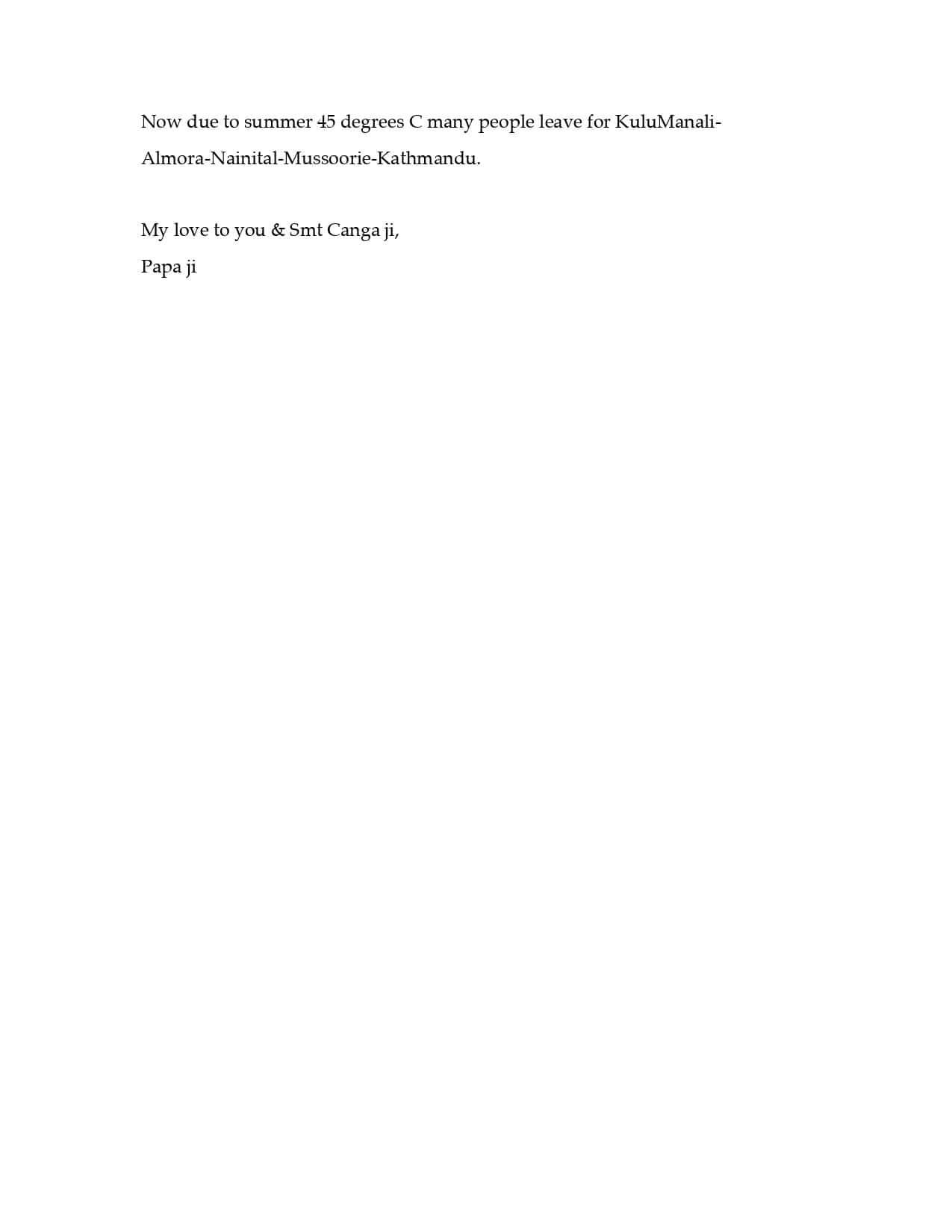
My love to Gang ji. There are many people here who have been blessed by her recently — Kery, who is here & likes to stay on forever. All those who come from Ganga ji are given special place in the Satsang Hall & are invited for private meetings.
Now due to summer 45 degrees C many people leave for KuluManali-Almora-Nainital-Mussoorie-Kathmandu.
My love to you & Smt Canga ji, Papa ji
The last letter in the sequence, and fittingly its subject is the book. Papaji has received four copies of Wake Up and Roar, Volume 2, and is delighted — the color, the layout, the photographs all “excellent.” Then the striking gesture: he gives the book wholly to Eli, urging him to sell and publish it through his own media rather than issue a cheaper edition in India. The teacher hands the work to the student. Around it runs the texture of 1993 — Papaji securing his passport and Delhi visa for the coming journey, planning Bodh Gaya, Sarnath and Kathmandu, and relaying Catherine Ingram’s note that the title “Keep Quiet” didn’t sound attractive to Western eyes.